
The best slide of my career: example of conceptual problem-solving
Many MBB consultants struggle to understand what conceptual problem-solving is. This post helps to understand this important skill. And I share a real example, the best slide of my career

In MBB consulting, we create too many slides. Some of them are important, and some are not so much.
God knows how many slides I created in my 9 years at McKinsey. Thousands? Probably tens of thousands.
But I know what the absolute best slide of my consulting career was. And I will show it to you later in this post.
It was the best not only in terms of out-of-the-box thinking, but also in terms of the impact it created. It helped me to turn around a failing project and unlock a huge transformation for the client organization.
I am pretty proud of that slide.
But also, it was a great example of conceptual problem-solving.
You know, at McKinsey, we make a big deal out of conceptual problem-solving. It has disproportionate weight and emphasis in performance reviews. The more senior you are, the more important it becomes.
Interestingly enough, at BCG and Bain, the term conceptual problem-solving is not widely used. But it’s still a must-have skill, even though it’s not called that.
If you are branded as a poor conceptual problem-solver, it can be a big problem hindering your consulting career. You don’t want that stigma, believe me.
But as a consultant, I was always confused about what that really meant.
Initially, I just thought it was being good at drawing conceptual boxes on slides. Then, I thought I had to use more fancy frameworks. And finally, I believed I needed to add more cartoon pictures on my slides to make it look slick.
Only later did I realise that was a fundamental problem-solving skill.
This post is a part of a series of posts where I go much deeper into problem-solving topics by sharing real-life examples from my consulting and coaching work.
From my coaching practice, I see that using real examples helps consultants better understand critical theoretical concepts and apply them in practice.
Let’s start with a definition.
Conceptual problem-solving is the ability to understand a problem at its essence, strip away noise, and solve it through clear concepts rather than raw data or brute-force analysis.
We actually use it in our lives all the time. For example, it is like explaining complex business processes as a system of pipes and bottlenecks.
Let me explain.
Imagine you have a difficult problem to solve. You’ve done a complex analysis. You ended up having lots of conflicting signals, not all of which are important. You know the client won’t be able to comprehend that complexity. That’s when you come up with a simple concept telling the story you want to tell.
Let me give you a real example.
This happened on a real project of mine. I created a simple but powerful concept that captured the people’s imagination and helped to unlock a huge impact for clients, the firm, and me personally.
But first, we need to build up some context for you to understand it. Bear with me. It may take some time. But the reward will be significant. I promise.
Situation
A few years ago, I joined a failing project as a senior Engagement Manager.
The project was already 4 weeks in when I joined it. Clients were super unhappy with the previous consulting team. They asked partners to replace the whole team. As a result, the EM and three consultants were rolled off that project.
Partners brought me in to turn around this project. It was a crisis management situation. I brought with me a distinctive consultant, the best one I have ever worked with.
The situation felt like a scene from the movie Pulp Fiction, when the main protagonists hired a man to clean up the murder scene in 40 minutes. And when that person arrived, he said, “I am Mr. Wolf. I solve problems.” That’s how I felt starting that project.
The stakes were extremely high. That was the start of a 2-year transformation program. If that project failed, we would not only lose that transformation but also the biggest client in the office. You can imagine how senior partners were nervous about it.
No pressure.
Complication
We worked for a few days, and the first big problem appeared.
The client leadership team couldn’t agree on financial targets.
The shareholders set quite an ambitious target, which was non-negotiable. But then, it wasn’t clear how to split that big number between different business units.
The commercial guys said that they cannot grow revenue anymore. The market is too competitive.
The operations guys said they cannot reduce costs anymore. They have already cut as much as they could.
That was a tough stalemate. No one wanted to budge. Their careers were on the line.
We tried to appeal to their rational minds. We cut numbers in different ways.
But the clients were in complete denial. They just rejected everything we proposed. The project couldn’t go beyond that point. Partners started to get very nervous.
Solution
We sat down together with the BA in a team room to problem-solve.
It was clear that we were facing not a mathematical challenge, but a communication one. The solution was clear. Everyone in the client’s team had to chip in and carry the weight. But we had to come up with a powerful concept that they would find fair.
We tried many ideas and finally came up with the one we really liked.
What if we use a Chess Game analogy?
We drew a chessboard grid on a slide. The X-axis represented growth in revenue, and the Y-axis represented cost reduction. The cells represented the financial outcome, depending on X and Y inputs.
We calculated all the possible outcomes and created a few scenarios to achieve the desired target. We turned these scenarios into chess moves:
Queen ♛, Rook ♜, and Knight ♞.
OMG, we loved that idea! It all fit so elegantly.
Here’s how it looked (sanitized).
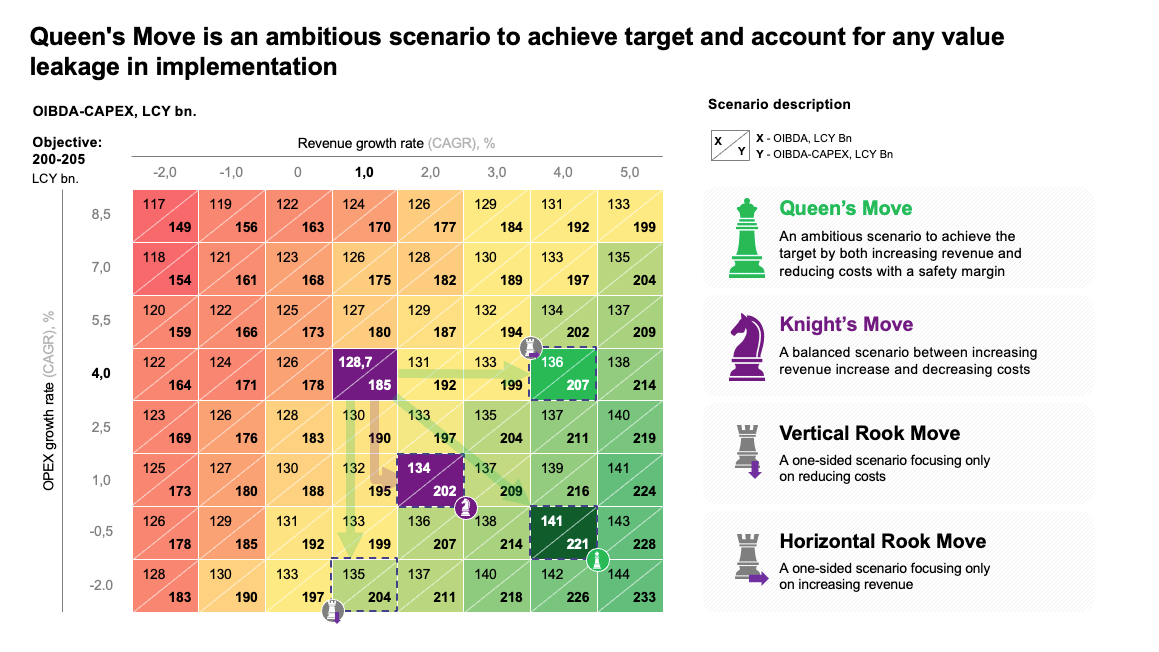
Here’s the sanitized version of that slide.
The first purple cell is a starting point. That was last year’s financial results. The other four highlighted cells represent the results of potential target scenarios.
Basically, we used one of my favorite techniques, the sensitivity matrix.
It’s very helpful in situations when you need to show different solution scenarios. You don’t solve for clients, you make them see and choose themselves. It’s perfect for business case discussions when you have two-dimensional inputs resulting in different outputs.
We sent a pre-read document to the Chief Strategy Officer in the company. He was a very senior and influential guy, an ex-MBB partner.
He called me immediately and said that he loved that slide and was looking forward to the next day’s leadership meeting.
That was a great start. Needless to say, our partners were ecstatic as well.
The next day, we had a meeting with the whole C-suite team.
We showed our slide. We could see how something clicked in their minds. They understood that they had to work together to meet the shareholders’ target. Everyone had to weigh in. The math was undeniable. And we presented a fair compromise.
They liked this concept so much that they called the whole project: A Queen’s Move. Btw, the Queen’s Gambit TV show was aired only 1 year later. Otherwise, we would have called it like that.
Anyway, we resolved that stalemate, and the project started going well.
But most importantly, that was the turning point for our team. We earned clients’ trust and respect. They started to feel happy with our work. And working on that project became much easier.
Fast forward one year.
That transformation was hugely successful. They actually massively overdelivered on the target in 1 year instead of 2, as they initially planned.
For me, that was also a profound insight.
I was shocked by how much one idea, one concept, can create so much impact, capturing people’s imagination and moving a huge company to action.
The funny part is, the senior partner loved that slide so much that, for many years after that project, he kept sharing it with other teams as the best slide he had ever seen.
Learnings
I know this story sounds like a war story from an old man.
But I just wanted to share this with you to appreciate the power of ideas and concepts.
That’s what real strategy consulting is. It’s not only about analyses and insights. We work with people. And communication is an important part of our work.
You can create a tremendous impact with your ideas and concepts. You can excite people, create shared purpose, and mobilize companies for change.
But you must invest time and effort in practicing it. It takes time to develop this skill to the level where it becomes a valuable tool in your hands.
That’s what conceptual problem-solving is at best.
If you are an MBB consultant and want to improve your performance through personalized coaching support:
We will discuss your pain points, challenges, and aspirations: no strings attached, just straight answers to your biggest questions.
If you want to learn more about my coaching program, read this post:
The coaching program for MBB consultants.
Beautiful validation :)
Great example -- and a ready response whenever someone posts the "consulting is dead" nonsense on LinkedIn. ChatGPT can't do this :)