
I struggled with problem-solving
Most consultants hear “improve problem-solving” and start learning more frameworks. But the real gap is not theory. It’s the lack of a systematic thinking process. Let’s discuss what that means.

‘You must improve your problem-solving.’
This is what my evaluator told me after my performance review. These words hit me like a ton of bricks.
‘You are not smart enough,‘ that's how I understood him.
I knew it was extremely dangerous feedback, as problem-solving is the most critical development dimension at McKinsey.
Actually, let me tell you more and up the ante:
Poor problem-solving is the root cause of all your problems in consulting.
Every challenge you experience can be traced back to it: negative feedback, poor ratings, sleepless nights, staffing challenges, weak sponsorship, unbearable stress, and constant insecurities.
When your outputs are not that impressive, they lead to all of those ‘fun prizes’.
But when you fix it, everything changes.
If you can produce high-quality, insightful outputs that impress your partners, they’ll like your work, and they‘ll like you by extension.
You’ll get access to exciting projects, inspiring leaders, cool career opportunities, and, most importantly, you will feel confident, stress-free, and fulfilled.
But let’s get back to my story. At that time, I decided to do everything I could to never get questioned on my problem-solving.
But learning problem-solving was extremely hard.
I started with in-house training and courses. I learned all available frameworks and approaches: the seven-step approach, MECE structuring, the pyramid principle, issue trees, hypothesis trees, and many other fancy things.
To my big surprise, all these frameworks were never used in real practice. Partners and managers demanded them, but I never saw what great looks like in practice.
That's where I got stuck. I didn't know what to do next.
I asked my managers how they learned it.
But they couldn't explain it. They learned intuitively through repetition and experience.
I had to resort to a trial-and-error approach. It was a highly ineffective and time-consuming process, full of mistakes, pain, and stress.
So I had to learn it the hard way.
But after working at McKinsey for 9 years and coaching dozens of consultants,
I developed a simple system to improve problem-solving.
Think of problem-solving as a multi-layered onion.
1. Communication
2. Slide-making
3. Core problem-solving
4. Critical thinking
5. Intrinsics
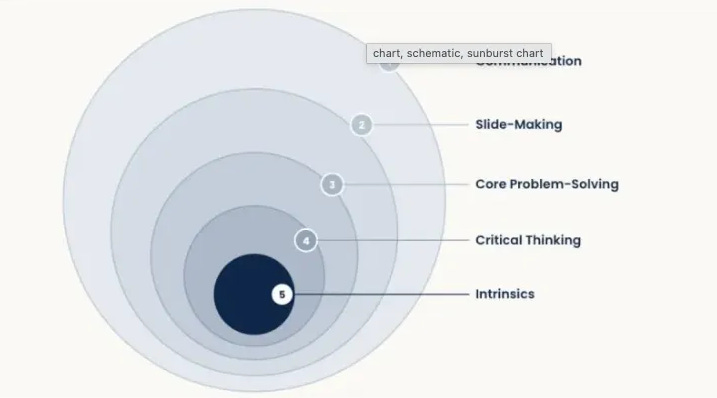
If you have noise in any of these layers, partners will think you don’t have it.
They won't do an in-depth analysis of your challenges. They will simply label you as not smart. But in reality, you might just make some silly, technical mistakes.
That's why, rather than trying to teach every possible problem-solving framework, I help consultants clear the noise and make their ideas stand out.
It’s much more practical and faster, and it helps to solve immediate pain.
And I see again and again, when consultants fix the noise, they discover they are apparently smart and creative problem solvers. And partners can see that as well.
If you are an MBB consultant and want to upgrade your problem-solving, I wrote an Ultimate Guide on how this system works and what common mistakes consultants make at each layer.

If you are an MBB consultant and want to improve your performance through personalized coaching support:
We will discuss your pain points, challenges, and aspirations. No strings attached, just straight answers to your biggest questions.
If you want to learn more about my coaching program, read this post:
The coaching program for MBB consultants.