
Why do we need frameworks?
Many consultants treat frameworks as a box-ticking activity. This post is for MBB consultants who want to learn why frameworks matter and how to use them.

We love frameworks in MBB consulting.
Maybe even a little bit too much.
But when I was a consultant, I had a very superficial understanding of why we needed them. I thought it was just something partners always insisted on.
That’s why I did them without sufficient care or effort. I just copied some frameworks from practice documents.
But it was a huge missed opportunity.
In this post, I discuss why we use frameworks and how you can make them your super tool for better problem-solving and communication.
But first, let me start with a funny story.
Once, I staffed a high-performing consultant on my project. He was smart and capable.
As one of the first tasks, I asked him to create a list of client questions. I wanted us to keep track of them so that we don’t forget them.
Instead, he created a framework of an ancient temple with a roof, pillars, and a foundation.
I was confused why he created a framework when I just needed to keep track of simple questions, which most likely would end up in the backup anyway.
Then I understood. He just couldn’t make a simple slide. He pushed to overdeliver and structure his work.
His good training kicked in. Someone taught him that he had to do that. But he didn’t fully understand the purpose of frameworks and applied them in all situations.
I was laughing really hard.
I said that I would give him a high score for the effort, but a low score for being wrong. In consulting, it’s also very helpful to be right. It’s not just the effort that counts.
Fast forward a few years, and he had become a highly successful EM. The best consultant I ever worked with.
Recently, he texted me, reminding me of that funny story. And he sent me that slide, slightly improved and sanitized.
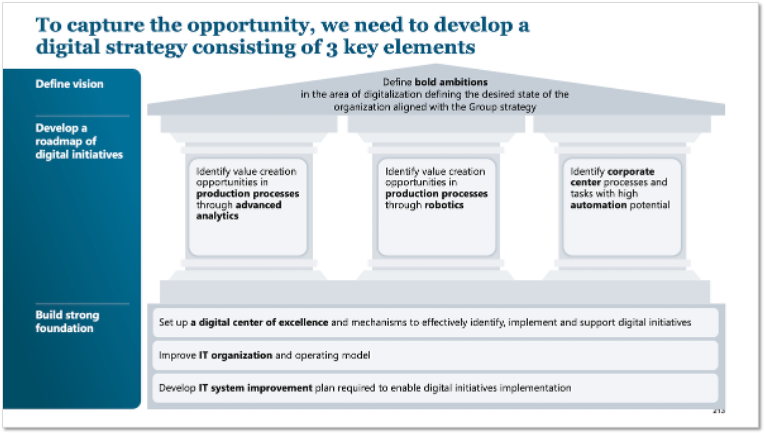
By the way, don’t take it as a best practice framework. Some can call it a never-dying classic. I think it’s a little bit outdated. I like a bit more tailored and modern frameworks.
If that was not the right use of frameworks, what is it then?
First, let’s start with understanding why partners need frameworks.
Structure
Frameworks help to show the structure of the project.
One of the biggest concerns partners have at the beginning of each project is whether the team has structured the project in the right way and that they don’t miss anything important.
They want to prevent a nightmare situation, when, at the end of the project, the team discovers that they haven’t done a big chunk of the project scope or missed some important question.
Why? Well, when the project ends, the budget will run out, and their team will be taken away from them. Partners will be left with the problem on their own. They don’t want to end up in this situation.
Frameworks help them to check the structure. That’s why partners will be quite demanding about that.
Approach
Frameworks help to show your approach to solving the problem.
It’s the second reason why partners need frameworks. It’s important to show clients that you have a scientific approach and you know what you are doing as a firm. You don’t work chaotically and haphazardly.
Also, a good framework helps to navigate clients through a complex project. In every meeting, you can remind them of the approach, where you are in the project, and which component you are discussing today.
This way, clients understand what’s happening right now, why you don’t discuss dozens of things at the same time, and why we focus only on this subset of issues.
Otherwise, if they don’t have that mental structure, they will pull you in different directions. That will create chaos and frustration.
That’s why a great framework should be introduced in the first days of the project, and then can be used as a navigation map throughout the whole project.
Now you know why it’s important.
Let’s discuss the next question.
How do you create good frameworks?
When I was a consultant, I always looked at practice documents for inspiration. It’s not a bad place to start from.
But later, I tried to create my own frameworks tailored to specific client situations and problems at hand.
Here, it’s important to be absolutely clinical in structuring. If your structure is not MECE, partners will go absolutely ballistic.
I won’t spend too much time explaining structuring. If you want to learn more about good structuring, read this post:

Design
With frameworks, it’s critical to be a little bit more sophisticated in design.
Generally, I preach for simpler and more functional design. But with frameworks, design will play a more important role.
The main reason is that you won’t have tons of content in frameworks. If you make it in an amateurish way, your partners will kill it before even showing it to clients. Because partners worry about how you represent the firm and not dilute the credibility.
That’s why you need to make it look more professional and aesthetically pleasing.
Questions and Answers
I really like this one approach to using frameworks.
I would write key strategic questions in frameworks.
And then, as the project progresses, replace questions with answers.
This way, clients can see how the project is shaping up and how the strategic recommendations are being built.
Closing thoughts
To wrap up, my main message here is that frameworks are not another useless chore that partners ask you to do. It’s an important instrument for you to structure your work and take your clients on a problem-solving journey with you.
That’s how you can stand out from others.
That’s how you can win.
If you’re an MBB consultant and want personalized coaching to improve your performance and become a confident consultant:
We will discuss your pain points, challenges, and aspirations. No strings attached, just straight answers to your biggest questions.
If you want to learn more about my coaching program, read this post:
The coaching program for MBB consultants.